
Still using a phone system that makes simple tasks feel expensive? Wondering why one vendor says you need VoIP, while another insists on hosted PBX? Fair question. In the hosted PBX vs VoIP conversation, the confusion usually starts because people compare a specific deployment model to a broader technology category – a bit like comparing a serviced office to electricity.
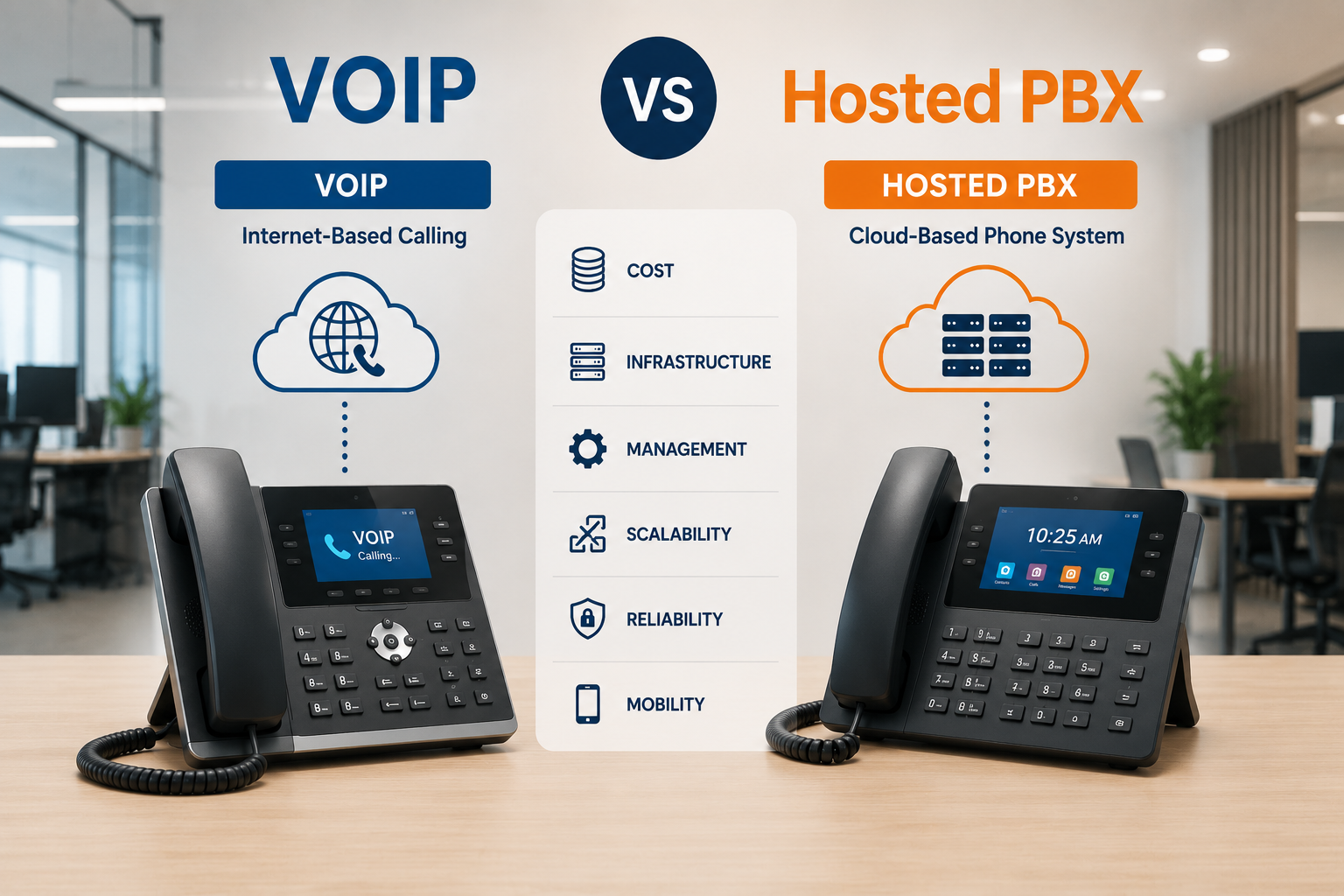
For business leaders, that distinction matters. The right choice affects monthly cost, IT workload, call quality, scalability, remote work support, and how quickly your team can respond to customers. If you are evaluating a new business phone system, it helps to separate the marketing language from the actual operational impact.
Hosted PBX vs VoIP: What is the difference?
VoIP stands for Voice over Internet Protocol. It is the technology that lets voice calls travel over an internet connection instead of traditional phone lines. If your office phones, desktop apps, or softphones place calls through the internet, you are using VoIP.
Hosted PBX is one way to deliver VoIP. PBX stands for Private Branch Exchange, which is the business phone system that manages extensions, call routing, voicemail, auto attendants, call groups, and similar functions. When that PBX is hosted, the provider runs it in the cloud rather than your business maintaining the PBX hardware on site.
So the simplest answer is this:
- VoIP is the underlying calling technology.
- Hosted PBX is a cloud-managed phone system that typically uses VoIP.
That is why the phrase hosted PBX vs VoIP can be misleading. In many cases, hosted PBX is a type of VoIP solution. The real comparison is often hosted PBX vs on-premises PBX, or basic VoIP calling vs a full business phone platform.
Why businesses mix them up
Many providers use VoIP as a catch-all term. Sometimes they mean internet calling only. Sometimes they mean a complete cloud communications platform with mobile apps, call recording, analytics, and CRM integration.
That creates a problem for buyers. One quote may cover only dial tone and extensions. Another may include advanced call management, deployment, support, and administration. On paper, both may be labeled VoIP.
For procurement teams and IT managers, the better question is not, “Do we want VoIP?” It is, “What type of VoIP deployment fits our business, our internal IT capacity, and our service expectations?“
What you get with a hosted PBX
A hosted PBX gives you business telephony features without maintaining the PBX server in your office. Your provider manages the core platform, while your users connect through IP phones, mobile devices, laptops, or conference endpoints.
For many organizations, the appeal is straightforward:
- Lower upfront infrastructure costs
- Faster rollout across multiple users or sites
- Easier support for hybrid and remote teams
- Centralized management and updates
- Predictable monthly billing
This model works well for companies that want business-grade calling without dedicating internal resources to PBX maintenance. It is especially useful when offices are expanding, relocating, or supporting distributed staff.
A hosted PBX also tends to be more feature-rich than very basic VoIP services. That matters if your teams rely on hunt groups, receptionist consoles, call queues, voicemail-to-email, call reporting, and integration with collaboration tools.

What people mean when they say VoIP
When a business says it wants VoIP, it may mean one of three things.
- First, it may simply want to replace analog or ISDN-style lines with Internet-based calling. In that case, the priority is lowering line costs and modernizing voice connectivity.
- Second, it may want an on-premises IP PBX. That still uses VoIP, but the PBX equipment is installed and managed at the customer site.
- Third, it may want a cloud calling platform, which is often a hosted PBX by another name.
This is why technical scoping matters. Two organizations can ask for VoIP and end up with very different systems.
Hosted PBX vs VoIP on cost
Cost comparisons depend on what is being replaced and how much control you want in-house.
Hosted PBX usually shifts spending from capital expense to operating expense. You pay recurring subscription or service fees, and the provider manages the platform. That makes budgeting easier, especially for small and mid-sized organizations that prefer to avoid major hardware investments.
An on-premises VoIP PBX may have lower recurring platform fees over time, but it comes with higher upfront costs. You need the PBX hardware or appliance, configuration, maintenance, backups, and support planning. If your business already has capable IT staff and a stable infrastructure, that model can still make sense.
There is also a hidden cost angle. A cheaper service that lacks responsive support, failover planning, or proper call quality tuning can become expensive when users start missing calls or raising tickets every week.
Set up and IT workload
This is often where the decision becomes clearer.
With hosted PBX, the provider handles the platform layer. Your internal team still needs to think about internet reliability, LAN readiness, device rollout, and user onboarding, but the telephony core is off your plate.
With an on-premises VoIP system, your team owns much more of the environment. That can be a strength if you want full control. It can also become a burden if your IT team is already managing servers, cybersecurity, cloud apps, endpoint devices, and network performance.
If your organization has limited in-house telephony expertise, hosted PBX is often the safer operational choice.
Features and business flexibility
A modern business phone system is not just about making and receiving calls. It shapes customer experience and internal responsiveness.
Hosted PBX platforms are typically built for flexibility. Users can move between desk phones, mobile apps, and desktop clients with less disruption. Administrators can add extensions quickly. Multi-site routing is simpler. Changes do not usually require a technician on site.
A basic VoIP service may offer calling at a lower entry cost, but feature depth can vary widely. Some plans are suitable for very small teams that only need direct calling and voicemail. Others fall short once the business needs reporting, call queues, department routing, or receptionist workflows.
For customer-facing teams, these details matter. A sales desk, service team, or front office usually needs more than just an internet-based dial tone.
Security and reliability
No phone system should be selected on features alone. Voice service is business-critical.
Hosted PBX providers usually build in redundancy, platform monitoring, and managed updates. That reduces the burden on internal teams, but it also means your provider choice matters a great deal. Not all hosted services are equal in uptime, support responsiveness, or service design.
On-premises VoIP gives you more direct control over the environment, but you are also responsible for patching, resilience, and recovery planning. If power, hardware, or connectivity fails, how quickly can you restore service?
Either approach can be reliable when designed properly. Either approach can also be frustrating if it is deployed without adequate network readiness, QoS policies, and support coverage.

Which option fits your business?
For small businesses, hosted PBX is often the more practical route. It reduces infrastructure complexity, supports growth, and keeps administration manageable.
For mid-sized organizations, the answer depends on internal IT maturity, compliance requirements, and the level of standardization required for effective communication across departments or locations. A hosted PBX often delivers the best balance of control, features, and support when remote work and multi-device access are part of daily operations.
For larger enterprises, both models can work. Some prefer hosted environments for faster scaling and simpler branch deployment. Others keep parts of telephony on premises because of integration requirements, internal governance, or site-specific needs.
If your business has any of the following priorities, hosted PBX usually deserves serious consideration:
- You want predictable monthly costs
- You have limited in-house telephony support
- Your workforce is hybrid, mobile, or multi-site
- You need to scale users up or down quickly
- You want one partner to handle deployment and support
If your business needs tighter local control, already has capable voice engineers, or has specialized integration requirements, an on-premises VoIP PBX may still be a strong fit.
Questions to ask before deciding
Before comparing quotes, clarify the operating model you actually need.
- Ask whether the proposal includes only VoIP connectivity or a full PBX feature set.
- Confirm who manages moves, adds, and changes.
- Check what happens during an internet outage.
- Review handset support, mobile app quality, security controls, and escalation procedures.
Most importantly, evaluate the provider’s implementation and support capability.
Phone systems are not just products. They are a business infrastructure. A trusted partner should understand your call flows, user groups, branch setup, and growth plans before recommending a platform.
The best decision usually comes from matching the system to the way your business operates, not from chasing the lowest monthly number. If a provider can explain your options clearly, map them to your workflows, and support the system after go-live, you are already asking the right questions.