
Who still has the spare office key? Is it in a drawer, with a former employee, or enjoying a long holiday in someone’s bag? For companies comparing the best door access security systems in Singapore, those questions are more than workplace comedy. They reveal whether access to people, equipment, and sensitive areas can actually be managed.
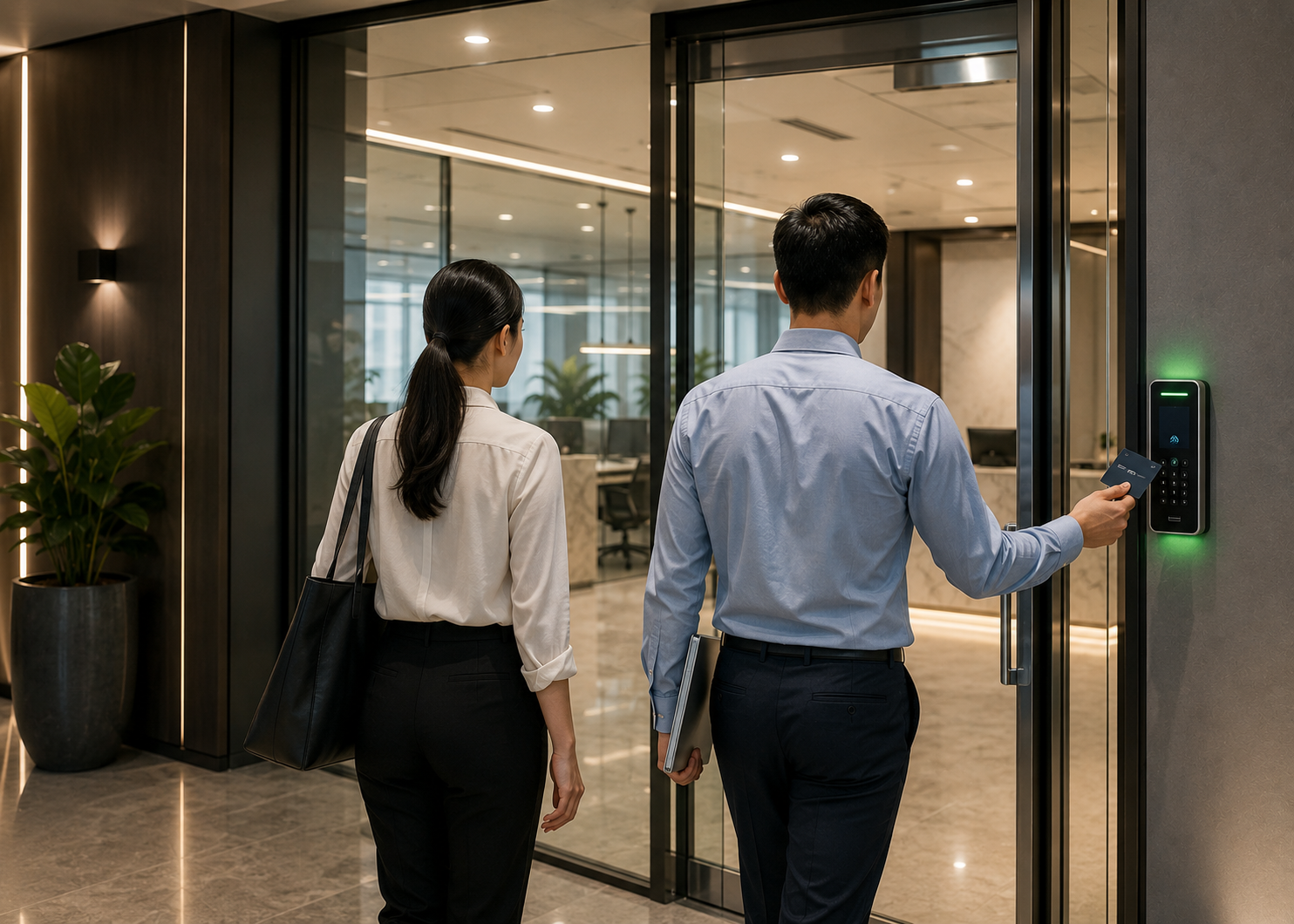
Door Access System in Singapore
A commercial access control system should do more than replace a physical key. It should give authorized people the right access at the right time, create an audit trail, and reduce the burden on administrators. The right choice depends on your site layout, security priorities, user volume, existing network, and how much visibility your team needs across locations.
What Makes a Door Access System Right?
The best system is rarely the one with the longest feature list. It is the one that fits the way your organization operates without creating a new administrative headache.
For a small office, a cloud-managed reader with mobile credentials may be enough. A warehouse may need weather-resistant devices, door-held-open alerts, and access schedules for shift workers. A larger enterprise may require centralized administration across multiple sites, integration with visitor workflows, and reporting that supports compliance reviews.
A business-ready solution should address five practical areas:
- Identity: Who is requesting entry, and how is that person verified?
- Authorization: Which doors, areas, and time periods should they be allowed to access?
- Control: Can administrators add, remove, or change permissions quickly?
- Visibility: Can the business review access events and exceptions when needed?
- Continuity: Will authorized users still be able to enter safely during a network or power interruption?
That last point deserves attention. Cloud administration is useful, but doors should not become unusable because an internet connection has an issue. Controllers, credential policies, backup power, and fail-safe or fail-secure door hardware must be specified correctly for each opening.
Types of Door Access Security Systems
Rather than treating one technology as universally superior, start with the access method that suits the risk level and working environment.
#1 Card and Key Fob Access
RFID cards and key fobs remain common in offices, schools, commercial buildings, and industrial facilities. They are familiar, quick to issue, and simple for most users to understand. An administrator can deactivate a lost card without rekeying locks throughout the premises.
Their main limitation is that a card can be shared, misplaced, or copied if low-security credential formats are used. For higher-risk doors, choose encrypted credentials and combine them with another verification method where appropriate.
#2 Mobile Credentials
Mobile access lets staff use a smartphone through Bluetooth, NFC, or an approved application. It can reduce the ongoing handling of physical cards and make onboarding easier for organizations with frequent staff movement, contractors, or hybrid work patterns.
Mobile credentials are not automatically better for every site. Some employees may not use company-managed phones, and a clear policy is needed for lost devices, personal-device access, and battery-related exceptions. A sensible deployment often keeps cards available as a backup.
#3 PIN Keypads
PIN entry is useful for restricted rooms, temporary access, and locations where issuing credentials to every authorized user is impractical. It is also commonly paired with cards or mobile credentials for two-factor access.
A PIN alone is less reliable for accountability because it can be observed or shared. If a confidential room uses a shared code, the access record may show that a code was used but not necessarily which individual entered. Regular code changes and individual PINs improve control.
#4 Biometric Readers
Biometric options, such as fingerprint or facial recognition readers, can provide stronger assurance that the credential holder is physically present. They are often considered for server rooms, research areas, high-value storage, or other sensitive zones.
However, biometrics bring privacy, consent, data retention, and operational considerations. In Singapore, businesses should assess their Personal Data Protection Act obligations, establish a clear purpose for collecting biometric data, protect it appropriately, and provide a practical alternative process where needed. The system design should match the sensitivity of the area, not simply the appeal of advanced technology.
#5 Cloud-Managed Access Control
Cloud-managed platforms centralize user administration, access schedules, activity logs, and multi-site visibility. For organizations with lean IT teams or several branches, this can reduce the need to manage separate systems at each location.
The decision should include more than subscription cost. Ask where data is hosted, how accounts are secured, whether multi-factor authentication is supported for administrators, what happens if connectivity is interrupted, and how easily the system can be exported or expanded later.
Choosing The Best One
Many access control projects go wrong before hardware is selected. A company may order readers first, then discover that the door frame cannot accommodate the chosen lock, the fire door requires different hardware, or the network cabinet has no capacity for the controller.
Begin with a door-by-door assessment. Identify entrances, internal restricted areas, emergency exits, loading bays, server rooms, meeting spaces, and areas used by vendors or visitors. Each door has a different purpose and risk profile.
For every opening, clarify these questions:
- Who needs access: employees, managers, cleaners, contractors, or visitors?
- Is access needed at all times, only during business hours, or by shift schedule?
- Should entry require one credential or two factors?
- What should happen during a fire alarm, power loss, or network outage?
- Does the organization need an audit record for entry, exit, or both?
- Will the door connect to an existing IP network, or does cabling need to be installed?
This approach prevents over-specifying low-risk doors while under-protecting critical areas. It also produces a clearer budget because door hardware, cabling, power supplies, controllers, software, and installation are considered as one working system.
Integration Matters
A reader on the wall is only one part of the solution. For meaningful operational value, access control should sit comfortably within the wider business technology environment.
Integration with IP networks can support centralized management and remote administration. Connection with video surveillance can help security teams review an event when a forced-door or denied-access alert occurs. Visitor management workflows can issue time-limited credentials rather than relying on manual sign-in books.
Some organizations also connect access events with building systems, such as elevator control, alarm monitoring, or occupancy processes. These integrations should be planned carefully. A complicated setup that nobody can maintain is not a security improvement.
For businesses upgrading communications, networking, or cloud services at the same time, a single technology partner can help coordinate network readiness, segmentation, Wi-Fi coverage for mobile access, and ongoing support responsibilities. Data Dynamics Singapore applies this problem-first approach across business infrastructure projects, helping teams evaluate the operational requirements before committing to a technology design.